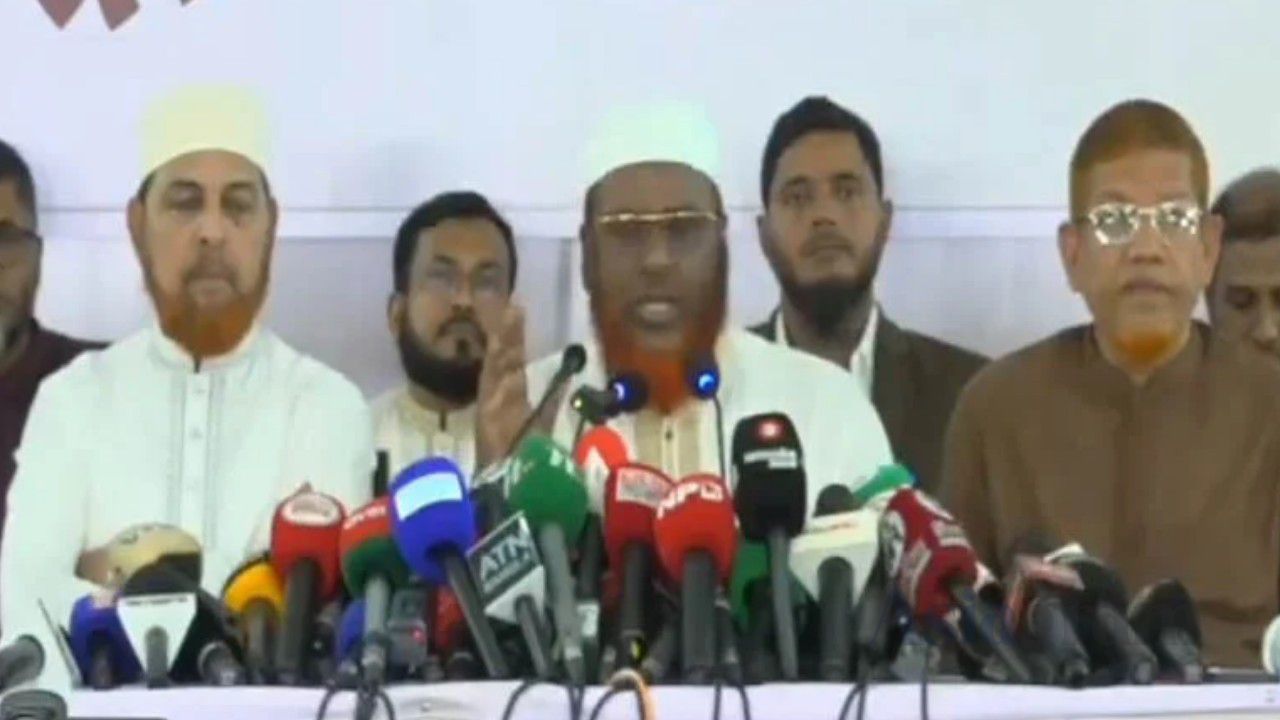
Jamaat Criticises BNP Government’s First Six Months
Bangladesh
Jamaat-e-Islami has criticised the BNP-led government’s first six months in
office, saying it has failed to deliver any major achievement that matches
public expectations.At a press conference
at Al-Falah Auditorium in Moghbazar, Dhaka, on Tuesday, Jamaat Secretary
General Mia Golam Parwar said the government had failed to make significant
progress on issues including implementation of the July Charter, law and order,
energy security, commodity prices and banking-sector reforms.He said the
government should now be assessed on the basis of its actual performance,
political commitment and accountability rather than its promises.‘No visible progress on July Charter’Mia Golam Parwar
alleged that the government had not taken effective steps to implement the
results of the February 12 referendum and the July National Charter.According to him,
the ‘Yes’ vote received 47,225,980 votes against 21,960,231 ‘No’ votes. He said
the government should have initiated the constitutional reform process based on
the referendum result but had instead moved towards an alternative
parliamentary process.He also claimed
that none of the 30 major reform proposals in the July Charter—including
limiting the prime minister’s tenure, introducing a bicameral parliament,
strengthening the president’s powers, ensuring judicial independence and
strengthening local government—had been implemented during the first six
months.Energy crisis remains a concernThe Jamaat leader
also criticised the government over the energy situation.He claimed that
Bangladesh’s daily gas demand is around 3,800 million cubic feet, while supply
stands at roughly 2,700–2,800 million cubic feet, leaving a daily shortfall of
about 1,000 million cubic feet.According to his
assessment, the energy shortage has affected industries, power plants and CNG
stations. He claimed industrial production had fallen by around 40 percent,
while about 20 factories had shut down and nearly 20,000 workers had lost their
jobs.Questions raised over law and orderMia Golam Parwar
also expressed concern over the country’s law-and-order situation.Citing data
attributed to different monitoring bodies and the Police Headquarters, he
claimed that 915 murder cases were recorded between March and May 2026,
compared with 767 in the whole of 2025 and 794 in 2024.He also raised
concerns over robbery, kidnapping, theft, violence against women and children
and mob violence.Criticism over rising prices and banking sectorJamaat also
criticised the government over the cost of living.Mia Golam Parwar
cited Bangladesh Bureau of Statistics data showing that overall inflation stood
at 9.16 percent in June 2026, while food inflation was 8.60 percent and non-food
inflation 9.61 percent.He said that
although inflation had eased slightly, the overall price level remained high,
putting additional pressure on low- and middle-income families.On the banking
sector, he said default loans had reached around Tk 5.88 lakh crore by March,
accounting for 32.26 percent of total outstanding loans.He alleged that the
government had failed to make visible progress in reducing default loans,
addressing liquidity problems in weak banks or restoring depositors’
confidence.Jamaat calls for eight-point actionAt the press
conference, Jamaat placed an eight-point set of recommendations before the
government.The demands
include:
Publishing
a time-bound roadmap for implementing the referendum verdict and July
Charter
Adopting
a comprehensive strategy to address the gas and energy crisis
Keeping
the administration and state institutions free from partisan influence
Taking
effective measures to improve law and order
Strengthening
efforts for Rohingya repatriation and adopting a clearer foreign-policy
framework
Taking
action against market syndicates, middlemen and abnormal profiteering to
control prices
Restoring
discipline and confidence in the banking sector
Recovering
defaulted loans and ensuring the security of depositors’ funds
Mia Golam Parwar
said the people had given the government a mandate to solve problems, not
merely explain them.He warned that if
the government fails to overcome its shortcomings and deliver visible changes
in the coming months, public frustration and the crisis of confidence could
deepen.