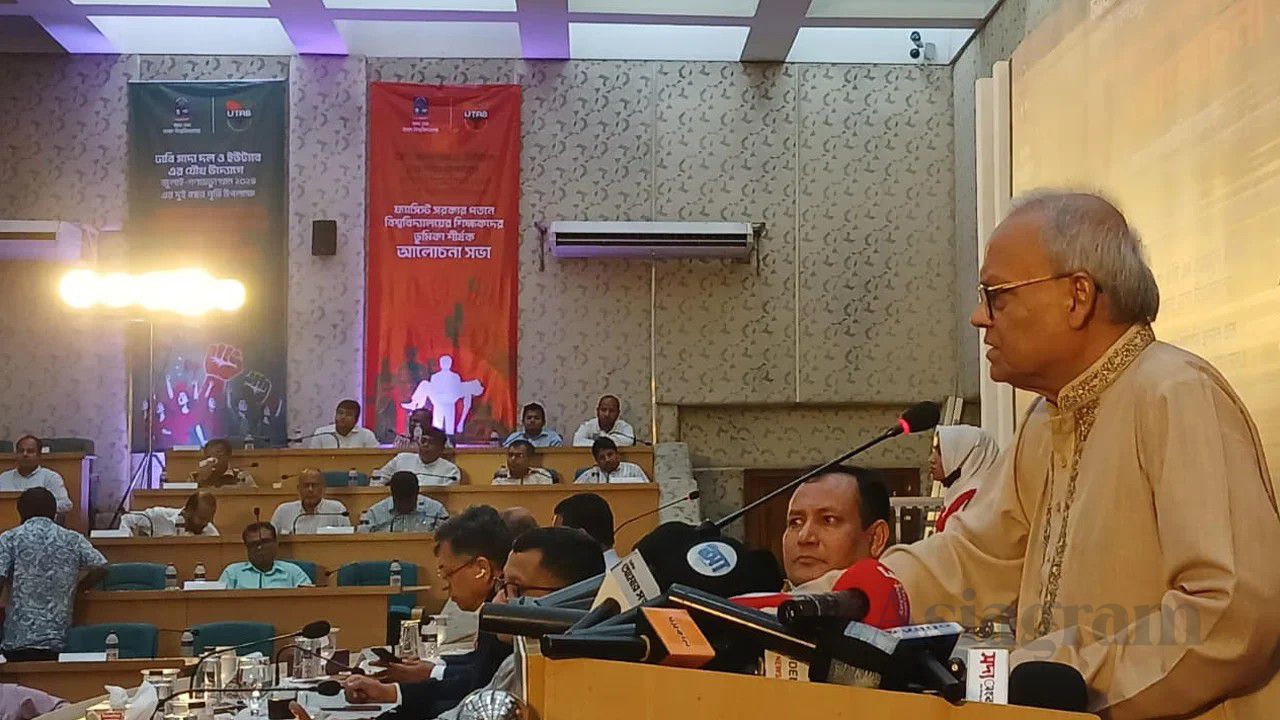
BNP Senior Joint Secretary General Ruhul Kabir Rizvi has questioned how former prime minister Sheikh Hasina was allowed to address an event organised by an international organisation in Delhi without approval from the Indian government.“If the organisation is independent, as India says, can an international organisation hold any kind of event in Delhi without government permission?” Rizvi asked.He made the remarks on Saturday morning at a discussion organised by the Dhaka University White Panel and the University Teachers Association of Bangladesh (UTAB) at the Nawab Nawab Ali Chowdhury Senate Building, marking the second anniversary of the 2024 mass uprising.Rizvi said an international organisation recently arranged an event in Delhi where a “fugitive fascist” was given an opportunity to speak. He said both the BNP and Bangladesh government had protested the matter.According to Rizvi, the Indian government has said the organisation concerned is independent and therefore the government has nothing to do with the event.He questioned whether such a position was acceptable.“If a foreign individual or organisation could be stopped from carrying out activities in India or Bangladesh during the previous government, why is the Indian government now saying it has nothing to do with an event where a fugitive fascist was allowed to speak?” he asked.‘India’s position is contradictory’Rizvi referred to the case of British lawyer Lord Carlile, who came from London during the Sheikh Hasina government to represent BNP Chairperson Khaleda Zia in legal proceedings.He claimed Carlile was not allowed to enter Bangladesh and was also denied an opportunity to hold a press conference in Delhi.Rizvi described India’s current position as a “double standard” and said the issue was a matter of concern for the BNP.On foreign policy, he said Bangladesh should maintain friendly relations with other countries but should not accept the dominance of any foreign power.“Friendship will remain in our foreign policy, but we will not accept the supremacy of any country,” he said.‘July uprising was a people’s movement’Rizvi said the July uprising was not the movement of any particular individual or group but a mass uprising driven by the sacrifices of ordinary people.He claimed that 15 to 20 rickshaw pullers and 95 workers were among those killed during the movement.“This was a massive uprising of the people as a whole,” he said.According to Rizvi, the July uprising was the culmination of 17 years of continuous movements and public grievances against injustice, repression and foreign influence.He said Bangladesh’s people had historically resisted aggression and colonial influence and that the July uprising represented the latest manifestation of that resistance.Calls for scrutiny of changing narrativesRizvi also called for careful examination of those who now speak in softer tones about the previous government or suggest that the country was better off under Sheikh Hasina.Referring to a recent exhibition at the residence of the Jamaat-e-Islami amir, Rizvi said photographs of Sheikh Mujibur Rahman’s March 7 speech, the Liberation War and the July uprising were displayed there.However, he claimed that there were no photographs, statements or posters of a key figure of the Liberation War whom he described as a freedom fighter and the declarer of independence.Rizvi said the absence was significant and warranted further analysis.He also questioned whether recent calls to improve relations with India and forgive the Awami League after August 5 could be linked to the current political situation.He stressed that the sacrifices of July, the history of the Liberation War and Bangladesh’s sovereignty should not be viewed separately.
সহজ ও দ্রুত খবরের আপডেট পেতে আমাদের অ্যাপটি ইন্সটল করুন।