
Tuesday, September 1, 2026
Daily Asiagram

Minister Calls for Strong Halal Ecosystem to Diversify Bangladesh’s Exports

Minister Calls for Strong Halal Ecosystem to Diversify Bangladesh’s Exports
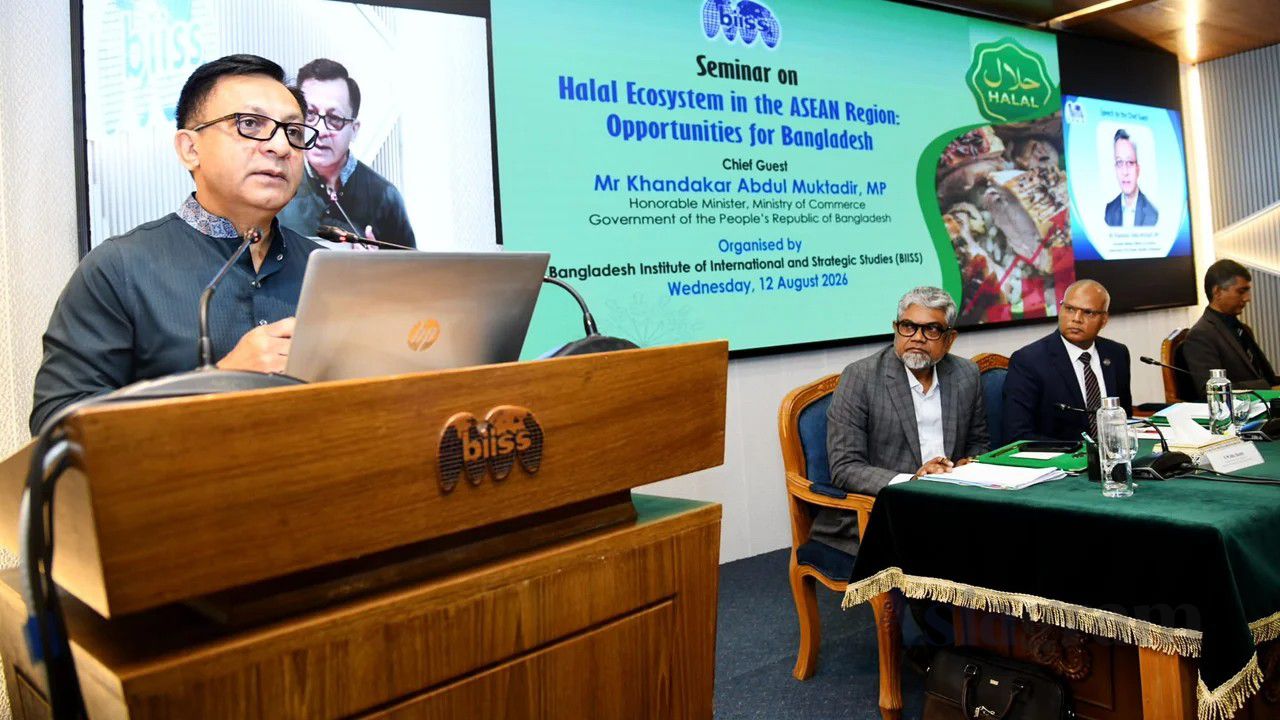
Commerce Minister Khandker Abdul Muktadir

Bangladesh needs to reduce its reliance on traditional export products and explore emerging sectors to strengthen its position in global trade, Commerce Minister Khandker Abdul Muktadir has said.

He called for building a strong, internationally recognised halal ecosystem by drawing on the experience of ASEAN countries.

The minister made the remarks as the chief guest at a seminar titled “Halal Ecosystem in the ASEAN Region: Prospects for Bangladesh”, organised by the Bangladesh Institute of International and Strategic Studies (BIISS).

Halal economy goes beyond food

Muktadir said the halal economy can no longer be viewed as being limited to food and beverages.

“It is now a broad global economic system encompassing food, pharmaceuticals, cosmetics, modest fashion, tourism, logistics, technology, financing and international certification,” he said.

He stressed the need to increase domestic production capacity to boost exports.

“First, we need to increase our own production capacity. For this, both domestic and foreign investment are necessary, and we must ensure a safe and attractive environment for investors,” the minister said.

He also highlighted preferential market access as an important factor in attracting investment.

Following Bangladesh’s graduation from the least developed country (LDC) category, the government is pursuing free trade agreements (FTAs), preferential trade agreements (PTAs) and economic partnership agreements (EPAs) with various countries to retain export advantages, he said.

Need for credible halal certification

The minister called for an independent, reliable and internationally recognised halal certification system in Bangladesh.

Such a system would increase global confidence in Bangladeshi products and help exporters access new markets, he said.

Speakers at the seminar said Bangladesh’s export sector has remained heavily dependent on readymade garments for years. To remain competitive in global trade, the country needs to diversify both its products and markets.

They identified the halal economy as one of the major emerging opportunities.

Malaysia offers a model

Experts said demand for halal products is rising worldwide, not only in food but also in pharmaceuticals, cosmetics, fashion, tourism and lifestyle products.

They noted that Malaysia’s halal ecosystem could serve as an important example for Bangladesh.

Malaysia has developed halal as a comprehensive economic system covering production, research, certification, marketing and exports rather than treating it simply as a product category, they said.

Bangladesh, meanwhile, has a large domestic market and established capabilities in agriculture, food processing, pharmaceuticals, leather and garments. These sectors could help the country become an important participant in the global halal supply chain, speakers said.

Five priorities outlined

The seminar identified five strategic priorities for making Bangladesh’s halal sector internationally competitive:

  1. Establish an internationally recognised national halal assurance framework.
  2. Develop specialised halal industrial clusters with modern laboratories and logistics facilities.
  3. Upgrade existing industries to meet international standards and improve competitiveness.
  4. Engage small and medium enterprises (SMEs), researchers and young entrepreneurs.
  5. Promote the “Bangladesh Halal” brand globally through economic diplomacy.

BIISS Director General Major General A S M Ridwanur Rahman delivered the welcome address, while BIISS Research Director Dr Mahfuz Kabir presented the keynote paper.

Akhtar Hossain, deputy director of the Halal Certification (Livestock) Division of the Islamic Foundation, and S M Abu Sayeed, deputy director of halal certification at the Bangladesh Standards and Testing Institution (BSTI), took part in the panel discussion.

Speakers said halal products could become a new pillar of Bangladesh’s exports if the country can ensure not only religious compliance but also product quality, safety, transparency and international credibility.

They stressed that coordinated government initiatives, private investment, international cooperation and an effective halal ecosystem would be essential for Bangladesh to move beyond being merely a halal product exporter and establish itself as a significant hub in the global halal market.

Topic : Halal Economy Export Diversification ASEAN Experience

Daily Asiagram

Tuesday, September 1, 2026


Minister Calls for Strong Halal Ecosystem to Diversify Bangladesh’s Exports

Published Date : August 12, 2026
featured Image
Bangladesh needs to reduce its reliance on traditional export products and explore emerging sectors to strengthen its position in global trade, Commerce Minister Khandker Abdul Muktadir has said.He called for building a strong, internationally recognised halal ecosystem by drawing on the experience of ASEAN countries.The minister made the remarks as the chief guest at a seminar titled “Halal Ecosystem in the ASEAN Region: Prospects for Bangladesh”, organised by the Bangladesh Institute of International and Strategic Studies (BIISS).Halal economy goes beyond foodMuktadir said the halal economy can no longer be viewed as being limited to food and beverages.“It is now a broad global economic system encompassing food, pharmaceuticals, cosmetics, modest fashion, tourism, logistics, technology, financing and international certification,” he said.He stressed the need to increase domestic production capacity to boost exports.“First, we need to increase our own production capacity. For this, both domestic and foreign investment are necessary, and we must ensure a safe and attractive environment for investors,” the minister said.He also highlighted preferential market access as an important factor in attracting investment.Following Bangladesh’s graduation from the least developed country (LDC) category, the government is pursuing free trade agreements (FTAs), preferential trade agreements (PTAs) and economic partnership agreements (EPAs) with various countries to retain export advantages, he said.Need for credible halal certificationThe minister called for an independent, reliable and internationally recognised halal certification system in Bangladesh.Such a system would increase global confidence in Bangladeshi products and help exporters access new markets, he said.Speakers at the seminar said Bangladesh’s export sector has remained heavily dependent on readymade garments for years. To remain competitive in global trade, the country needs to diversify both its products and markets.They identified the halal economy as one of the major emerging opportunities.Malaysia offers a modelExperts said demand for halal products is rising worldwide, not only in food but also in pharmaceuticals, cosmetics, fashion, tourism and lifestyle products.They noted that Malaysia’s halal ecosystem could serve as an important example for Bangladesh.Malaysia has developed halal as a comprehensive economic system covering production, research, certification, marketing and exports rather than treating it simply as a product category, they said.Bangladesh, meanwhile, has a large domestic market and established capabilities in agriculture, food processing, pharmaceuticals, leather and garments. These sectors could help the country become an important participant in the global halal supply chain, speakers said.Five priorities outlinedThe seminar identified five strategic priorities for making Bangladesh’s halal sector internationally competitive: Establish an internationally recognised national halal assurance framework. Develop specialised halal industrial clusters with modern laboratories and logistics facilities. Upgrade existing industries to meet international standards and improve competitiveness. Engage small and medium enterprises (SMEs), researchers and young entrepreneurs. Promote the “Bangladesh Halal” brand globally through economic diplomacy. BIISS Director General Major General A S M Ridwanur Rahman delivered the welcome address, while BIISS Research Director Dr Mahfuz Kabir presented the keynote paper.Akhtar Hossain, deputy director of the Halal Certification (Livestock) Division of the Islamic Foundation, and S M Abu Sayeed, deputy director of halal certification at the Bangladesh Standards and Testing Institution (BSTI), took part in the panel discussion.Speakers said halal products could become a new pillar of Bangladesh’s exports if the country can ensure not only religious compliance but also product quality, safety, transparency and international credibility.They stressed that coordinated government initiatives, private investment, international cooperation and an effective halal ecosystem would be essential for Bangladesh to move beyond being merely a halal product exporter and establish itself as a significant hub in the global halal market.

Daily Asiagram

Editor & publisher: Kayes Ahmed Salim
Copyright © 2026 Daily Asiagram | All Rights Reserved
Minister Calls for Strong Halal Ecosystem to Diversify Bangladesh’s Exports
0:00 0:00
1.0x