
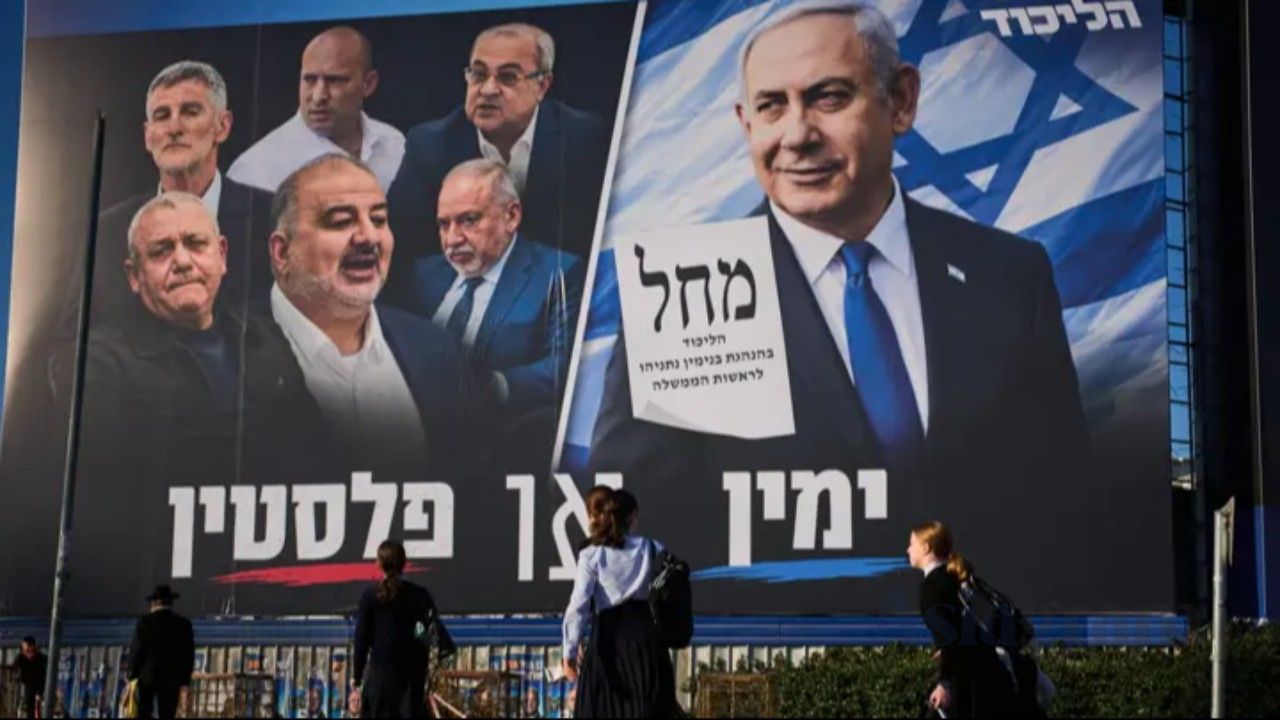
As Israel prepares for its upcoming general election on October 27, Palestinian citizens of the country are facing a difficult choice: whether to vote in a political system they believe has failed to protect their rights or stay away from the ballot box.
Many
fear that another government led by Prime Minister Benjamin Netanyahu and
far-right Jewish politicians could intensify repression against Palestinians.
Despite their deep mistrust of the political system, some are preparing to
vote, hoping their participation could help remove Netanyahu from power.
Palestinian
citizens account for around one-fifth of Israel’s population, making their
votes potentially decisive in the election. Opinion polls suggest that neither
Netanyahu’s right-wing bloc nor the parties opposed to his government are
likely to secure the 61 seats needed to form a majority in the 120-member
Knesset.
In
such a scenario, the support of Arab-led parties, including Ra’am and the Joint
List, could become crucial. If no bloc secures a majority, another election may
be necessary, leaving Netanyahu’s current government in office until a new
administration is formed.
First-Time Voter Hopes to Speak for Palestinians
Layla
Atamneh, a 19-year-old resident of Beit Hanina in East Jerusalem, will vote for
the first time in the election.
She
grew up watching her parents disagree over whether Palestinians should
participate in Israeli elections. Her father supported voting for Arab-led
political alliances, while her mother consistently refused to vote.
According
to Layla, her mother believes voting helps portray Israel as a democratic state
where Palestinian citizens enjoy equal rights, despite their experiences of
discrimination and humiliation and the growing influence of far-right
politicians.
Layla,
however, has decided to cast her ballot. She believes she has a responsibility
to represent Palestinians in the occupied West Bank and Gaza, who have no say
in choosing Israel’s next government.
“I
feel that I have to be the voice of these people. One person may not be able to
do much. But if my vote gives them even one percent hope, I will vote,” she
said.
Layla
also worries that Palestinian voices, particularly those of young voters,
remain largely absent from election debates. As an Arabic speaker, she finds it
difficult to follow much of the election coverage conducted in Hebrew.
Her
dilemma reflects the feelings of many Palestinian citizens who believe the
political system does not adequately represent their interests but fear that
another Netanyahu government could make their situation even worse.
Election Held Amid Growing Fears
Political
scientist As’ad Ghanem of the University of Haifa says the election is taking
place amid increasingly repressive policies against Palestinians.
The
war in Gaza, violence and displacement in the West Bank, and restrictive state
policies towards Palestinian citizens inside Israel have heightened concerns
about their future.
Hanan,
a 36-year-old Palestinian Christian woman living in a Druze village in the
Galilee region, says these fears have become more immediate.
Last
month, Israeli settlers living in illegal settlements in the West Bank
attempted to establish an outpost near the Palestinian town of Majd al-Krum in
the Galilee.
The
incident was followed by an election campaign video generated using artificial
intelligence and released by far-right Finance Minister Bezalel Smotrich. The
video depicted a Palestinian man in the West Bank calling a relative in the
Galilee in a frightened voice, warning that Jews were coming and would do to
them what they had done to Palestinians elsewhere.
Hanan
said such developments have increased her fears that settlers could become more
aggressive and attempt to seize additional Palestinian land.
Yet
she remains determined to vote and wants to encourage others to do the same.
“Before
every election, I tell myself I will not vote again because Arab
representatives seem unable to accomplish much. The lack of women’s
representation and the absence of new political voices are also disappointing.
But eventually, I go and vote, thinking that perhaps something will change this
time,” she said.
Attempt to Disqualify Arab Parties Sparks Anger
The
controversy surrounding Arab political parties has further deepened
Palestinians’ doubts about Israel’s political system.
On
September 23, Israel’s Central Elections Committee moved to disqualify the
Arab-led Ra’am and Joint List from participating in the election. The Joint
List is an alliance involving Hadash, Balad and Ta’al. The Supreme Court
subsequently overturned the disqualification decision.
However,
Balad leader Sami Abu Shahadeh withdrew his candidacy after the court indicated
that a majority of its judges might support disqualifying him.
Many
Palestinians viewed the episode as evidence of the political system’s
limitations. Others believe the attempt to exclude Arab parties could encourage
greater voter mobilisation.
“We
feel that we are under attack. That is why we will vote in greater numbers,”
said Thabet Abu Ras, an expert on Arab-Jewish relations.
In
the last five Israeli elections, turnout among Palestinian citizens ranged from
around 45 to 65 percent. In the 2022 election, it stood at approximately 53
percent.
A
person involved in Palestinian election campaigning said surveys suggest that
around 62 percent of Palestinian citizens could vote this time. Campaigners
hope to raise turnout to between 70 and 75 percent.
The
last time turnout among Palestinian citizens reached approximately 75 percent
was in 1999, when their participation helped Ehud Barak defeat Netanyahu and
become prime minister.
Higher
turnout could also affect smaller far-right parties, including Amcha Israel and
The Reservists, by making it harder for them to cross Israel’s electoral
threshold of 3.25 percent of the vote.
Ghanem
believes that a widespread boycott of the election is now a relatively marginal
position among Palestinians.
“We
are in real danger. We can also play a role in bringing this government’s term
to an end,” he said.
Arab Parties Could Hold the Balance of Power
One
of the central questions surrounding the election is whether parties opposed to
Netanyahu will cooperate with Arab-led political groups.
Opinion
polls suggest neither of the two main Zionist political blocs is likely to
secure the 61 seats required to form a government independently. This could
give Ra’am and the Joint List significant leverage in post-election
negotiations.
Despite
that possibility, prominent opposition leaders have expressed reluctance to
form a coalition with Arab parties.
Opposition
leader Naftali Bennett has said he would not form a government dependent on
parties that do not identify as Zionist. Former military chief Gadi Eisenkot,
another potential opposition candidate for prime minister, has also signalled
that he is unwilling to form a coalition with Arab parties.
This
leaves Palestinian voters facing a difficult calculation: whether to support
parties that best represent their political and national identity or back those
most likely to help remove Netanyahu from office.
Layla
initially considered voting for Ra’am, which has support among the Bedouin
population in the Negev, as well as the liberal Zionist Democrats party. She
eventually decided to vote for the Joint List because of her political
convictions.
“There
are things I can compromise on, but there are certain morals and values that I
cannot abandon so easily. As Palestinians, we have to support Palestinians,”
she said.
In
2021, Ra’am made history by becoming the first Arab party to join an Israeli
governing coalition. The coalition briefly kept Netanyahu out of power.
Ra’am
argues that participating in government can deliver practical benefits and
greater protection for Palestinian citizens. But critics say limited budgetary
gains cannot resolve the deeper questions of Palestinian identity and equal
rights.
Ghanem
has accused Ra’am leader Mansour Abbas of making excessive concessions to
secure relatively small budget allocations without addressing the fundamental
problems facing Palestinians.
For
many Bedouin citizens, however, everyday concerns remain a priority. They hope
political participation can help secure recognition for unrecognised villages,
greater investment in education and more employment opportunities.
Saving Lives Before Ending the Occupation
Ghanem
argues that Palestinian citizens remain politically weak because they have not
developed a sufficiently consolidated political force within their own society.
Nevertheless,
he believes the Joint List could play an important role in determining the next
government. Palestinian parties supported Yitzhak Rabin’s government from
outside the cabinet in 1993, and a similar arrangement could be possible again.
Removing
Netanyahu from power, Ghanem argues, does not necessarily require Palestinian
parties to join a governing coalition. What matters is whether they can work
with a broader political camp seeking to replace what he describes as a racist
government.
Last
week, Joint List leader Yousef Jabareen expressed willingness to support the
opposition under certain conditions. These include creating a path towards
establishing a Palestinian state and tackling organised crime and violence in
Palestinian communities inside Israel.
Abu
Ras hopes that, despite their public opposition to cooperation with Arab
parties during the campaign, opposition leaders will eventually reach some form
of understanding with them.
“If
Arabs elect 15, 16 or 17 members of the Knesset, everyone will come knocking on
their door. They may not want to admit it publicly, but I am certain their
position will change after the election,” he said.
Abu
Ras has lost 38 members of his family in Israeli attacks in Gaza. He does not
expect a Netanyahu-free government to bring immediate peace, but believes it
could at least help reduce the violence Palestinians face under the current
administration.
“Before
ending the occupation, I want to save my people,” he said.
A Choice Between Bad and Worse
Layla
believes she may have persuaded her mother to vote this time, driven by fears
that another far-right government could further worsen conditions for
Palestinians.
“There
is a bad situation, and there is an extremely bad situation. We will choose the
bad over the extremely bad. Even if we can prevent one death, one demolition
order or something similar, that is better than doing nothing,” she said.
Yet
her doubts remain. She worries that voting could also help Israel reinforce its
image as a democratic state without addressing the inequalities experienced by
Palestinian citizens.
For
Layla and many others, the election offers neither a clear solution nor an easy
choice. It is an attempt to influence a political system they distrust while
fearing the consequences of allowing it to continue unchanged.
As she put it, Sometimes it feels as though we have reached a dead end.
Thursday, October 22, 2026
Published Date : October 22, 2026